I was thinking today as I ate my breakfast, or maybe it was lunch, at any rate it was my first meal of the day, that people always talk about dreams as something desirable beyond all else. It goes without saying that if you have “realized a dream” in some way, you’ve accomplished or achieved something truly remarkable, at least according to your own standards. It’s like “What’s better than a dream?”… I’m just saying in the world of today, of America, of the 21st Century, I don’t know what, it’s just… universally accepted that if you have “made a dream come true,” there really is nothing left to seek after, am I right? A dream is the embodiment of the highest accomplishment a human being can hope for is it not? Maybe… Maybe not. At least, in the America I grew up in, it was pretty f—ing important.
But… at breakfast, or lunch, or whatever it was today, I realized something. I realized that, at their core, dreams… don’t make any sense. That’s a fundamentally defining characteristic of all dreams is it not? And so what can one conclude from that? Well, I would say that, basically, most people’s highest aspirations consist of seeking to realize or achieve something (a dream) that doesn’t make any sense.
People talk about “following your dreams” do they not? And if we can all agree that, almost across the board, dreams are inherently nonsensical things, then everyone advocating the idea of “following your dreams” is, by extension, advocating “following something that doesn’t make any sense.”
I’ve heard that lucid dreams can sometimes be less bizarre and nonsensical than regular dreams but that’s neither here nor there really since most people don’t know anything about lucid dreams.
I guess something deep down in me really takes issue with the idea of devoting so much time and energy to something that fundamentally has no order and no reason. It’s almost as if we revere dreams as something with a logic and sensibility all their own that we could never hope to understand, making the pursuit of them inherently worthwhile. Maybe its a zero-sum thing: like, well if you’re not going after your dreams, you’re going to wind up in your nightmares so it doesn’t really matter if they make sense or not because they’re better than nightmares.
On the other hand, isn’t regular life also more or less nonsensical? Maybe we just ascribe meaning and order to things that essentially don’t have any and thereby convince ourselves that dreams are mostly nonsense while life more or less makes sense. I can say from personal experience that I’ve always considered life to be kind of nuts, like not much different from a strange dream.
That’s more or less all I’ve got to say about it. I just wanted to share this revelation… that many people spend most of their lives pursuing things that… are totally bizarre and absurd.
I learned (by watching YouTube videos) that my car has what is known as a “Convergence Telematic Module” (CTM) stashed away behind the glovebox which can be accessed by removing several panels on the dash as well as the glovebox itself. This module controls the bluetooth functions of the car as well some important display information in the instrument panel (like the mileage) and, if it is malfunctioning, the mileage will blink on and off (the display is digital not analog). My car started doing this (flashing the mileage) so I searched on the web for the problem and discovered the things I just mentioned. Determined to fix it, I did a web search for the symptom I was experiencing (the flashing odometer) and got a bunch of hits. Ultimately, I boiled it down to the fact that my CTM was the cause of the issue (I hoped) and bought a new module on eBay for around $100 (brand new they can be $600 or more to say nothing of the labor if not doing it yourself). I researched where it was located in my vehicle (so I could replace it) and initially came to believe it was behind a panel next to the back seat on the driver side. But I’m glad I didn’t start digging around back there as I later learned that this module is only in that location when it comes to BRITISH versions of the the vehicle I own. In the AMERICAN version, the module is located, as I said, behind the glovebox, which actually made the process of getting to it quite a bit simpler. Anyway, I further searched for a way to access the module’s location in the AMERICAN versions of the car and found a very helpful video by a youtuber named Ele Truk (thank you!) who showed how to remove the glovebox. So, long story short, I had a problem, figured out what was causing it, got a piece that needed replacing, found out how to replace it, and did the work. I probably saved around $700 or more by not taking it to a professional mechanic too. Knowledge is power indeed. Or if not power, certainly worth a good deal of money.
I’m a big fan of Bruce Campbell, I can’t deny it. He has a great screen presence. He’s no Laurence Olivier but he’s just so much fun to watch. My rationale for liking him so much comes from, unsurprisingly, his most memorable role, that of Ash from “Evil Dead.” So many horror movies take themselves too seriously, they try to blow you away with gore, with suspense, with sheer jump-out-of-your-seat moments, or just how scary they can be. Bruce Campbell in “Evil Dead” always made me feel like it was scary and it was a horror movie but that at no point was there any real danger. Like somehow, consciously or unconsciously, he had the interests of his audience at heart. And even though he was only playing a character trying to save humanity from the forces of darkness, somehow, he was actually doing that too by subtly giving the proverbial wink and nod to everyone watching the film, reminding us not to get lost in the Hollywood shuffle. Intentions aside, Bruce Campbell is funny and he’s a leading man if there ever was one. Almost a caricature of a leading man, but a leading man nevertheless.
In 1997’s “Running Time,” one can see Campbell in good form. He delivers his characteristic tough guy demeanor and his no-nonsense approach to on-screen, in-character business. But Bruce Campbell isn’t the only thing about “Running Time” that makes it great.
Like Alfred Hitchcock’s “Rope,” the movie is intended to have the appearance of being cut-free, in other words, devoid of cuts from shot to shot. Most movies have hundreds of cuts. And although one can not (or perhaps could not because technologies have changed a lot over the last 30 years) truly make a cut-free movie (because rolls of film only translate to around 10 minutes of film time, at which point, you need to stop and reload the camera), this one was about as cut-free as they come, having around 30 in total which are hidden throughout the film. This style works very well with the subject matter of the film (a heist) where time is a crucial component of success. That was not an accident as you might expect. Becker, the director, intentionally created a script about a heist in order to use this technique of a cut-free movie. And, in case you are wondering, the idea for the style preceded the script and not the other way around.
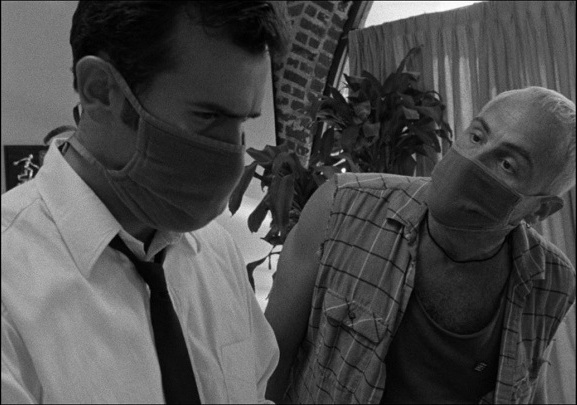
Having read through some history of the film from the director’s point of view, I can tell you that there are many more interesting things about this movie than just its shooting style, its resemblance to a play, Bruce Campbell, or the eerie prescience of the actors wearing surgical masks during the heist itself (hint: think recent worldwide health crisis). For instance, the movie is shot on 16mm ASA 64 Kodak black and white film. 64 ASA film is incredibly slow meaning getting the exposure right is very difficult. However, the image you end up with if you have exposed it well is very, very sharp and very very low grained. For comparison, Clerks was shot on something called Kodak Eastman Double-X which (if I have understood it correctly) has an ASA of around 200 indoors and 250 outdoors (though I don’t know why a film should be rated differently between indoors and outdoors). That’s like 4 times as fast as the film stock used to make “Running Time” and, if you hearken back to an image of Clerks, you will perceive how grainy it was and how sharp this is.
The movie definitely seems like a play, especially in the interactions between Campbell and Barone. The long take(s) just make it seem less like we (the audience) are seeing the characters on a screen and more like they are performing right in front of us. Barone’s acting is not stellar and neither is Campbell’s but that’s not why you go to see a Bruce Campbell movie as anyone who has seen one can probably tell you. You go to see a Bruce Campbell movie because he kicks ass, it’s kind of that simple. That said, the dynamic between Barone and Campbell is compelling, he with his Ex-con mannerisms and she with her down-on-her-luck-resorting-to-prostitution-to-pay-the-bills persona. It’s not high art by any means but their relationship is moving in a way. The idea that two wayward people can somehow come together to rescue each other from their own foibles is something I’ve always wanted to believe in and it’s a pleasure to see it on-screen in the form of this movie.
It’s not a perfect film mind you, it does have some problems. A lot of the camera work I think could have been better, there were many times when the focus was a bit off. But the nature of the movie pretty much assured that getting a perfect shot was never going to happen. Maybe you could get the focus just right if you had a hundred takes to do it but that couldn’t be done here. I also thought, when you come right down to it, there just wasn’t quite enough plot to really make a movie here. The heist itself isn’t quite enough and neither is the long lost romance between Barone and Campbell. The heist is great movie fodder but the more cleverly it is executed on-screen, the greater the pleasure of watching it take place and the less you need other plot points to make the movie sing. I recognize that the idea of the movie was that things were going wrong and the emphasis was on the psychological impact this had on the characters but heist movies do need energy and I thought this was a bit low on that. Take for comparison, the heist scene at the beginning of “Snatch,” by Guy Ritchie. There is a very slow build up of the characters entering the building and traveling to the appropriate floor via elevator and then just a few seconds of high intensity action as the heist is carried out. This sort of “smash and grab” film-making really shoots through your veins and a heist, in my opinion, must be shot in such a way that the audience experiences this rush.
Running Time, in short, is a lot of fun. It’s an innovative concept for a movie and for the most part, everything about it works really well. One of the biggest drawbacks to the medium of film is that it removes the audience from the action much more than a play does and this film, in some strange way, attempts to reconcile this. And, for the most part, it succeeds.
Seeing as how American and Chinese relations are, at this point in time, competitive, to say the least, I found “The Last Emperor” very interesting. It was such a sweeping grand narrative across, supposedly, the entire life of a single human being, albeit, an exceptional one. At the time of its release, it completely dominated the academy awards, as some films did once upon a time, and may still do now though I don’t watch the oscars regularly anymore nor do I follow new movies very closely. What is it about “The Last Emperor” that so enraptures the imagination? I think, to answer my own question, it is several things: 1) history, plain and simple. History has the capacity to fascinate us all in one way or another, though it can also be very boring paradoxically. And Chinese history in particular seems so rife with titillation for a Western Audience. 2) Ruling is something that the average individual dreams about perhaps more than anything else and this IS the story of a ruler. 3) The 20th century was fraught with upheaval on all fronts and this movie makes the most of China’s inwardly-focused upheavals. While America was scattered across the entire world for various militaristic and economic reasons throughout most of the 20th century, China was seemingly, again, inwardly-focused going through massive changes and power structure overhauls.
While the west was running around the globe, China was parked behind its national borders seething with tumult and chaos.
Somehow, this movie scrutinizes that inward-facing vision through an outward-facing lens, and does it well.
To be honest, I’m not really a history buff. I’m sure if someone examined my above assessment of China’s and America’s roles in the 20th century, they could poke it full of holes if they felt so inclined. But I do know that while I may not have my facts straight, I have the general idea right: the idea being that China’s political structure went through some massive changes in the 20th century while America’s political system was, by comparison, very calm and stable.
So presumably, if somehow the Chinese could make a movie about America’s 20th century global exploits using some kind of communal subject instead of a single individual, who knows, maybe they could produce something similar. The story of America’s 20th century global hijinks as told using a certain cohesive group of people as a subject, I like that.
I love traveling. I’m sure that sounds like a cliche but it’s true. I feel my most free when I am on my way somewhere new or even somewhere old. The exhilaration of movement is perhaps my favorite sensation in the world. A lot of people espouse this idea as I understand it: the idea that traveling is all they really want to do, if only they could quit their jobs and just travel the world. Makes sense I guess. It’s like the holy grail of human life if you ask me: finding a way to just keep moving on and on and on through the world never really having to worry about money and jobs and attachments and all the rest of it. I mean, isn’t that what some of the most popular social media sites are all about? Traveling around and taking pictures of oneself in exotic places, having new experiences everyday, just seeing new and interesting things forever? Well, who knows what the hell social media is really all about. I certainly don’t, and I’m not sure I really care anyway. All I know is, life usually doesn’t seem so bad when I’m going somewhere that isn’t home. I mean, travel has its hassles for sure, especially now with updated “security” measures all over the place, but still, for the most part, the pleasure of the journey is worth the BS.
I’m planning a trip with my father to the American Southwest that’s scheduled for about 3 months from now. I’m really looking forward to it but I hope I’m not setting myself up for a letdown.
I’ve taken a bunch of trips in the last 5 years or so and a lot of them have most certainly had their share of hassles but… they were all international. This is the first domestic trip I’ve taken in quite a while. That means… no language barrier, no customs, no sense of being a foreigner in the true sense of the word (although you are always a foreigner to some extent when you travel outside your customary circles), no currency exchange, and I won’t have to limit my cell phone usage to when I’m near a WiFi signal (maybe being able to use my cell-phone more often isn’t such a good thing but whatever).
The last international trip I took, I went to Belize and man, that did not go well. I won’t go into the details but I had to completely rearrange my plans halfway through it and the people with whom I originally set up the trip kicked me out of their group for no good reason. But I did do something cool while I was there, I took a bus from one end of the country to the other and I had a great time. It was insanely cheap and I was the only white guy on this old beat up school bus traveling down these dirt roads with lots of sunshine and palm trees and reggae music blasting over the stereo most of the way. I felt very self-sufficient and like a really accomplished traveler. You can bet your average American tourist has never traveled anywhere in a foreign country like the way I did on that trip. I mean, who knows, maybe they have but the point is not whether or not other people have done what I did but the way I felt doing it and the fact that it made me feel competent and accomplished at the time.
This trip, no more school buses. I’m going to be traveling in style. I’ve decided to rent a Jeep from a company called Turo, which I heard about through Doug DeMuro’s Youtube channel. I really, really wanted to get a convertible for this trip and all the traditional car rental agencies didn’t have one. Turo’s rates seemed ok and they were the only car rental company (traditional or otherwise) that offered an option for a convertible vehicle. We are going to be driving a long way too. We’re going through a lot of desert and mountains and a convertible just seemed like too good an opportunity to pass up. All route 66, roadside diners, Americana, and the open road with my head out the window and shit. Or something like that. That’s how I pictured it anyway, we’ll see how reality aligns with my expectations when I get there.
My own and my Dad’s interests seem to get more and more similar as we age in parallel. I don’t think I could have planned or executed this trip with him in my 20’s or 30’s. But now that I’m 40ish and he’s 80ish, I just feel like he and I have both relaxed our… our… well, I don’t know what exactly. Maybe I’m just rationalizing spending a lot of his money to take a trip for myself and bringing him with me. I mean, it was my idea and honestly, some of my ideas really don’t work out that well but he and I have both agreed that this is definitely something we want to do. I am optimistic about it.
Furthermore, the other trips I’ve taken in recent years have been planned exclusively by me. I’ve asked for advice here and there from this or that person but basically I did all the planning and I had the final say on everything I did. This time, we (my father and I) have really put our heads together and planned it jointly, sharing the responsibility of deciding where we go and where we don’t. I had the opportunity to put in my two cents as often as I liked but I don’t think I could have talked him into doing something he didn’t want to do. The trip (and the planning of it) feels moderately egalitarian and I like that about it. We came up with a bunch of really fun and interesting places to stay along the way although the places we stayed were mostly (again) my ideas. However, he did make one suggestion for a place to stay called “The Firetree Inn” which is on the Utah/Arizona border in the middle of the desert. It looks really cool to me. Here is the link to their website if you want to check it out: https://www.firetreeinn.com. I have no idea how the hell he found this place by the way. He said he did some kind of search for it but I don’t think I would have found it. Anyway….
A long time ago, when I was in Mexico with some friends from California helping to build an orphanage on the outskirts of Tijuana, I participated in something called a “sweat lodge” ritual. Basically, the sweat lodge is where you enter a small hut in which are placed several extremely hot stones upon which are poured buckets and buckets of water until the temperature in the hut gets very, very warm. There is chanting and you stay inside until you can’t take anymore. Then you emerge and you feel cleansed. You take a cold shower and your pores feel sparkly clean afterwards. It’s great. If you have the means to partake, I highly recommend it.
This hotel my father found reminds me a lot of the sweat lodge thing I did oh so long ago. And for that reason (among many others), I’m looking forward to it.
There are many other things about this trip I’m looking forward to although predominantly it is the traveling itself for which I can’t wait. Again, looking at this sentence, it does seem kind of cliche to me, talking about traveling on my blog but who cares, I’m pumped. I’ve never been to the Southwest before but I’ve heard a lot about it and seen plenty of pictures. I always think of it as kind of quintessentially American. You know, cowboy hats, sunsets, drive-ins, big open spaces, etc. I mean, the Southeast and Northeast have plenty of charm too but I still think of the Southwest as very characteristically and stereotypically American. I imagine that when outsiders think of what America is like having never been here themselves, they picture a landscape like the one in the Southwest. That’s all for now.
When I was a kid, I never thought much about what my life would be like when I got older. I was just too busy being miserable, being happy, playing sports, doing schoolwork, crushing on this or that girl, jumping on the trampoline in our backyard beneath the old oak tree, mowing the lawn, playing tennis, getting my license, etc etc. I don’t know exactly what I did with my time when I was younger but I didn’t waste it worrying about the future, I’m pretty sure about that.
So what really happens after you turn 40 years old? Well, obviously anybody past the age of 40 knows the answer to that question but everybody’s different am I right? I guess what I mean by that is: life after 40 for you won’t be the same as life after 40 for me. Maybe that’s obvious too but I think it deserves to be pointed out.
In some ways, the media would have you believe that, for all intents and purposes, you’re pretty much dead after you turn 40. There are so few representations of anybody outside of their teens, 20’s, and 30’s in mainstream media. It’s almost like the whole world forgets you exist once you no longer fall into one of those age brackets. You’re dead exactly, just nobody really pays much attention to you anymore. Maybe they never did in the first place even when you were younger but it’s like passing 40, they’re less concerned with you than ever. Does this sound depressing? I don’t mean it to. I’m just trying to draw attention to the idea that, past a certain age, well, it’s kind of up to you to decide what’s true and what isn’t. And by that, I just mean, there are fewer signposts and role models and images telling you who you ought to be, what you ought to look like, how you ought to behave, so on and so forth. The makers of those things tend to focus on a younger crowd.
So… is that a good thing or a bad thing? Is it liberating? Confusing? Sad? Do you have to unlearn all the crap they crammed down your throat when you were younger about what’s important in life?
Many people say that as middle age wears on, happiness increases. At least, a great deal of research supports that assertion as far as I know. And I think it’s very much because the media doesn’t make such a fuss about people past 40.
I turned 40 a little over a year ago and I feel like I’m still waiting for that whole “happiness” thing to happen. Maybe I’m just being impatient and I need to give it another year or so.
There’s a quote from a movie called “Waking Life” (one of my absolute favorites) in which a character utters the cryptic soundbyte: “…the systematic questioning of the idea of happiness.” Basically, he’s talking about feeling disillusioned with the world and how he and his compatriots ought to slough off the ideas and ambitions foisted upon them by their elders in an effort to… i dunno, be more authentic. A defining characteristic of this character and the group he finds himself in, however, is his (their) age. They’re clearly headstrong, idealistic young men. Kinda doesn’t sound like something an older man might say but who knows? After losing a bunch of worldly things like a house, a job, a wife, maybe someone older might redefine (or at least try to) what happiness is all about.
I’ll certainly say the pace has slowed significantly. It’s not quite as go, go, go anymore. Maybe it will be again one day but right now, it’s definitely not like that. I often feel listless and unsure about the choices I’ve made that have led me to where I am now. Like, what would life be like if I had done X instead of Y? But it’s sort of pointless to think about those things. Wasted mental energy or something.
Anyway, I’ve got some things coming up this year I’m really looking forward to and it’s never over till it’s over as they say. Who knows what life as an old geezer has in store for me… 😉
I’m unemployed right now and receiving unemployment insurance but it won’t last forever and the longer you’re on it, the less money you get. I really need a job or at least something to work towards. Finding that will be my biggest challenge I’m pretty sure. But it seems like it raises so many questions too: like, if I get a job, am I willing to relocate for it? And if I am, where would I go? How would I get there? Basically, earning income of some kind is the challenge. Hopefully, once something starts moving in that direction, the rest will fall into place.
Education is for you and you alone, it has no value outside the walls of whatever institution you get it from. It can teach you how to think in a way that makes a small amount of sense out of the world around you but the world around you will never share your perspectives.
When I was little, my father brought me many a Donald Duck comic book. I now own hundreds of them from all the comics he brought home to me as well as from my subscriptions. I have been rereading them of late and I find that they are as funny, poignant, and enjoyable now that I’m in my 40’s as they were when I was a preteen.
I think that a lot of my peers were reading superhero comics while I was reading Disney comics. Judging from my memory of their doodles in class anyway. Donald duck is a really wonderful creation, especially the way he appears in a lot of the comics from the 40’s and 50’s. This was when he was being drawn by a man named Carl Barks who created many characters within the Donald Duck universe in addition to drawing Donald himself.
Donald is a wonderful character for many reasons, not the least of which being his tendency to get in over his head very quickly with tricky situations and ornery people and then refuse to back down even when things seem hopeless. In a way, his obstinacy is purely selfish: he wants to win at any cost. But in another way, his easily provoked fury is his most endearing quality, at least from a reader’s point of view. When he gets well and truly mad, and goes berserk, his antics are some of the most entertaining things in the whole world.
But it’s not only that that makes his obstinacy endearing. As we, the readers, get caught up alongside whatever mission he happens to be on, naturally we identify with his plight or struggle and want him to persist. And his unfailing gumption when faced with adversity is what delights readers the most.
Of course, he doesn’t always win and he doesn’t always get so riled up that he goes berserk. As often as not, he becomes a whimpering, trembling puddle of feathers when faced with a problem and it is only through the violent, forceful coaxing of his nephews or other friends and relatives that he makes any attempt to bear up and take action at all.
Barring the above two scenarios, there is another side of Donald, which I would argue is reflective of his darker, more sinister nature. Occasionally, when a problem presents itself, Donald makes up his mind to cheat (or at least do something very unethical) with little to no compunction. Usually, when this side of Donald presents itself, his face (or at least the way Barks draws it), takes on a devilish appearance with a maniacal grin and sometimes he even sprouts little horns on his head. This side of Donald is usually short-lived however and either his evil, cheating plans fail and he is exposed for his crimes (instantly wiping away his devilish glee) or his conscience gets the better of him and he spends the rest of whatever story he is involved in trying to undo his mischief.
But what is it exactly that made (or makes) Donald Duck so irresistibly appealing and FUN? Although its possible I truly missed out on the superhero genre of comic book while devoting my childhood comic-book reading activities solely to Donald and Disney (for the most part), I regret nothing. Especially now, at the dawn of my middle age. To picture Donald’s face when he is engaged in an argument, or when he has caught one of his nephews in a lie, or when he is escaping a foe (having found himself in some dangerous entanglement), is to bring to mind all the wonderful things about being human, all those things one would want to do if the real world would just stop telling us we can’t. Donald, although a duck, is so very human himself in his frailties, his foibles, his desires, his impetuousness, his firey temper, his fear of danger, and his overconfidence in his abilities to do things with which he has no experience.
To my mind, Donald Duck very much embodies middle-class American values and qualities. I think that is one reason I began to revisit him, because all things middle-class are becoming so hard to find these days. That, and also just because they brought back some happy memories from childhood, memories of a simpler, less… interconnected time. But he’s not only “middle-class,” he’s also very ordinary and it’s this ordinariness that obviously sets him apart from the super-hero genre of comics but also makes all his adventures that much more fun to read about because it makes it that much easier to imagine ourselves (us poor run-of-the-mill average Joe’s reading comics) in his shoes, partaking in his extraordinary exploits.
To me, Donald Duck is a very comforting presence. Specifically, as he is drawn by Carl Barks. It’s probably because I grew up with him and I have powerful associations of comfort and safety and love surrounding these comics but I can only imagine that if I had never read these comics as a child and were just discovering them for the first time today, I would still feel the same way about them. I’ll never know. Donald, and the entire universe he inhabits, Duckburg and the world beyond it, is a familiar comfortable place for me. I’m deeply fond of it and it will always hold a special place in my heart. I’m sure most people don’t feel quite as strongly as I do about these things but who knows, maybe they do.
These comics were very much a product of bygone days: days when paper and ink were the only way of making a comic. Nowadays, seeing as everything is online and all of an artists’ tools are available in paid applications and whatnot, the level of craftsmanship, of depth of feeling, of understanding of human temperament are gone. Donald was very much a product of his age and that age certainly seems to be over as far as I can tell. But I’m deeply grateful I have copies of these wonderful creations and that I was able to revisit them the way I was.
Donald Duck, as drawn by Carl Barks, was and is a force to be reckoned with, a joy to behold, and a dyed-in-the-wool American artform in and of himself, if only you care to seek him out.